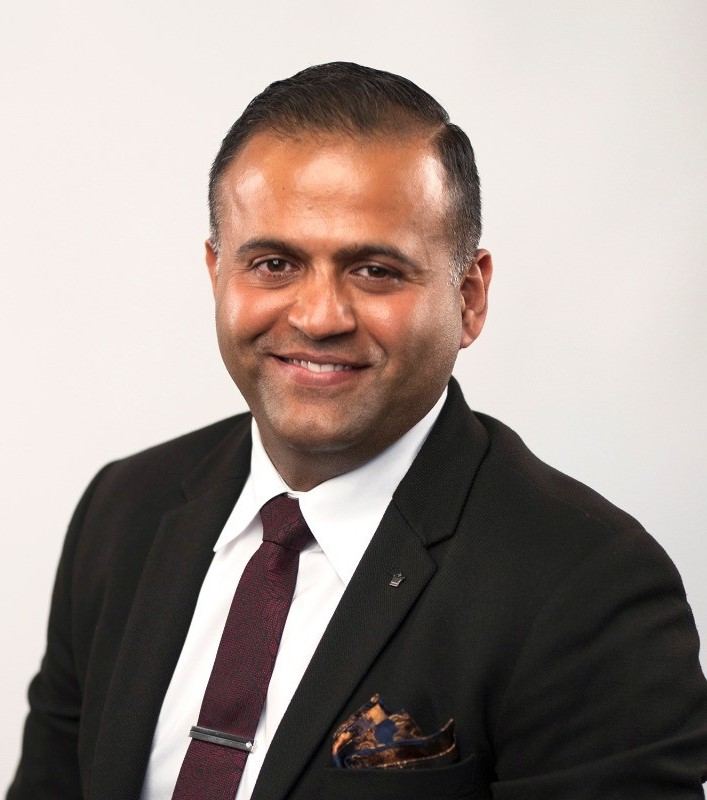
One of life’s greatest joys is connecting with people and sharing stories, which is the essence of our Cyber Leaders on the Move series. Our latest article features Jay Hira, Director, Cyber Security – Financial Services, Founder of MakeCyberSimple, university guest lecturer and Cyber Leadership Institute alum.
From the outset, Jay strikes me as a deep thinker who genuinely desires to help those around him. He embraces failure as a vital part of success, a lesson he shares with his children, especially his youngest daughter, saying, ‘Don’t think of failure as the opposite of success. Failure is a part of success.’
Jay likens failure to learning how to ride a bike. No one sees the failures. ‘Everyone sees you at the top of the hill,’ Jay explains. Jay has undoubtedly climbed quite the hill.
Jay grew up in a small, close-knit community in Gujarat, Western India. Life there was much more relaxed compared to the bustling city of Sydney, where he now resides. He didn’t need to look far for role models; his hardworking parents were his greatest influences. His father, a man of few words, embodied admirable strength and determination, while his mother, warm and curious, instilled in him values of compassion and empathy, a split he describes as classic good cop/bad cop.
Jay and his sister were raised by their grandmother, a well-respected community member and leader who taught Jay we are stronger together in a community. The lesson was firmly instilled after a school fight when she said, ‘People have this misconception about superpower. It’s not about how strong you are and fighting to prove you are stronger than others. Superpower comes from building a community [where] each one has a unique ability that contributes to the group,’ Jay recalls.
Jay’s community included dreamers, troublemakers, and bookworms like Jay, who confesses he was quite the introvert. Attending his first English-speaking school in Year 7 introduced him to the language, and he humorously notes that his youngest daughter is his harshest critic on grammar. ‘It’s always good to be surrounded by people that correct you and help you do the right thing,’ Jay says, reflecting his humility and eagerness to learn.
Jay’s desire to learn can be traced throughout his whole life. While his friends were on vacation or playing sports, Jay spent his time helping at his uncle’s computer hardware store, troubleshooting motherboards and assembling computers. This early exposure sparked his interest in computer science, though he acknowledges, ‘Life isn’t just about manifesting something, and you get it; it’s about putting in the work behind it.’
His hard work was evident, and Jay excelled academically, often outscoring his now-wife in school. However, a distracted final year meant he didn’t initially get into computer science. Instead, he began studying mechanical engineering but quickly realised it wasn’t his passion. Determined to pursue his love for computers, Jay earned his CISCO Certified Network Associate certification, topped his engineering class, and ultimately transitioned to computer science.
While at university, Jay’s additional studies in ethical hacking and forensic investigation helped him secure a role as a penetration tester at Wipro, where he was one of four chosen for unique abilities. Although he excelled in penetration testing, Jay sought to explore client-facing and advisory roles, leading him to a generalist position at KPMG. To become a well-rounded expert, Jay knew he had to be on the receiving end of the reports, implementing them. Jay transitioned to an operational role at IBM, managing Splunk and security operations and gaining firsthand experience with implementation complexities.
After solidifying his attack and defence mindset, Jay built solutions and integrated systems at Accenture, leading to international roles in Mauritius, The Netherlands, and Australia. Reflecting on his journey, he says, ‘It was almost like, what do I do now to challenge me and learn a new skill set?’ Since moving to Australia in 2012, Jay embraced various roles in professional services, likening the industry to ‘A vast ocean of multiple variables’ and noting that ‘Every day is a new experience.’
Jay is acutely aware of his strengths and weaknesses. Rather than focusing on working for specific brands or holding prestigious titles, his choices are guided by constant self-evaluation. He identifies and addresses gaps, understanding what serves him and when to move on. Like anyone, Jay has faced failure and self-doubt, but he embraces a philosophy close to my heart: you cannot control what life throws at you, but you can control how you react. ‘It’s about being conscious of what you can control and what you can’t and how you deal with challenges,’ Jay tells me.
This mindset has shaped his career journey, particularly as he transitioned into senior management. Reflecting on this shift, Jay provides an analogy, ‘It was like learning to dance, knowing you have two left feet…and trying to dance on a moving train.’ He describes it as exciting but to expect a few missteps along the way. As he navigated the complexities of leadership, from people management to strategic thinking, Jay learned the importance of surrounding himself with a community of like-minded individuals—a support system he found at the Cyber Leadership Institute.
Throughout our conversation, the importance of community emerges as a central theme, and I ask Jay what led him to the Cyber Leadership Institute (CLI). Having known Phil Zongo for years, Jay trusted that the Cyber Leadership Program (CLP) would provide the strategic mindset and skills he needed to advance to a director position. ‘It’s more than a structured program,’ Jay says. ‘It’s a gateway to a global network of exceptional cyber leaders.’
Jay immersed himself in the August 2021 CLP cohort and thrived. A core component of the CLP is the cyber strategy project competition, which gamifies cyber strategy design. The project assesses the ability to influence decision-makers, inspire high performance, and drive complex change. Jay was one of only three finalists selected to present his cyber transformation strategy to the board. He sums up his experience in the CLP with Three C’s that stood out: content, collaboration and community.
Jay says the CLI community offers strong support and the opportunity to learn from other’s successes and failures. His involvement with CLI is part of a broader philosophy he holds dear: the belief that our greatest legacy is the impact we have on others. Sharing a piece of wisdom from his grandmother, Jay says, ‘If doors don’t open for you, build a door and let others through.’ We laugh at the irony of this advice in the context of physical security, but its deeper meaning resonates. How do we uplift those around us once we’ve made it through the door?
As he gets older, Jay increasingly focuses on societal impact and giving back. Generous with his time and knowledge, he mentors many people. In 2021, he started a non-profit called MakeCyberSimple, which aims to make cyber security accessible for all. Through this initiative, Jay visits local schools to educate students about cyber security, helping them understand the implications of their actions online, such as the permanence of content on the internet.
In addition to his work with younger students, Jay seeks to bridge the gap between graduates’ academic knowledge and their ability to apply what they’ve learned in the industry. He developed A Sandbox of Education with his colleagues, a program designed to help students apply their knowledge to real-world situations. This program presents undergraduates with case studies relevant to current industry problems, challenging them to find practical solutions.
This focus on real-world application ties into Jay’s broader view on solving industry challenges, which he reflects on through his early experiences at Wipro, ‘Some of the best cyber security practitioners I work with haven’t had a computer science degree… they come from different backgrounds like actuarial, law, or construction work.’ Jay believes that diverse backgrounds contribute to more innovative solutions, noting, ‘The more people challenge you, the better the solutions.’
He underscores that leaders in the industry must ensure diversity goes beyond a tick-box exercise. ‘It’s very simple; you have to make sure you drag people into conversations where decisions that are being made will impact them,’ Jay declares. ‘Where they can’t have a seat at the table, listen to them and understand them and then be their voice.’
Given the industry’s stress and demands, I ask Jay how he manages. ‘To unwind, I focus on what fuels my soul, whether it’s spending quality time with family, connecting with friends, and pursuing passion projects that make a difference in the world,’ he shares. ‘Work-life balance isn’t about separating the two. They’re a part of who you are. If you think about work as outside of life, you’re probably not in the right job or passionate about what you do.’ His not-for-profit and educational initiatives reflect Jay’s values of living in the moment, giving back, embracing discomfort, and building resilience. His strong sense of purpose and commitment energises him, even on the toughest days.
Remembering his earlier mention of a love for books, I enquire about his current reading. Jay responds, ‘I get a lot out of every book I read. I’ve just finished the insightful The Diary of a CEO by Steven Bartlett.’ One of his all-time favourites is Inner Engineering by Sadhguru, which emphasises that happiness comes from within, not external factors — a philosophy Jay applies to all aspects of life.
I ask Jay for the best advice he could offer aspiring cyber security professionals, and his response echoes the Cyber Leadership Institute’s belief that ‘We are stronger together’ as he reinforces the importance of community. ‘Never stop learning,’ Jay advises, ‘Cyber security is constantly evolving and has many layers of complexity. None of us have all the answers.’